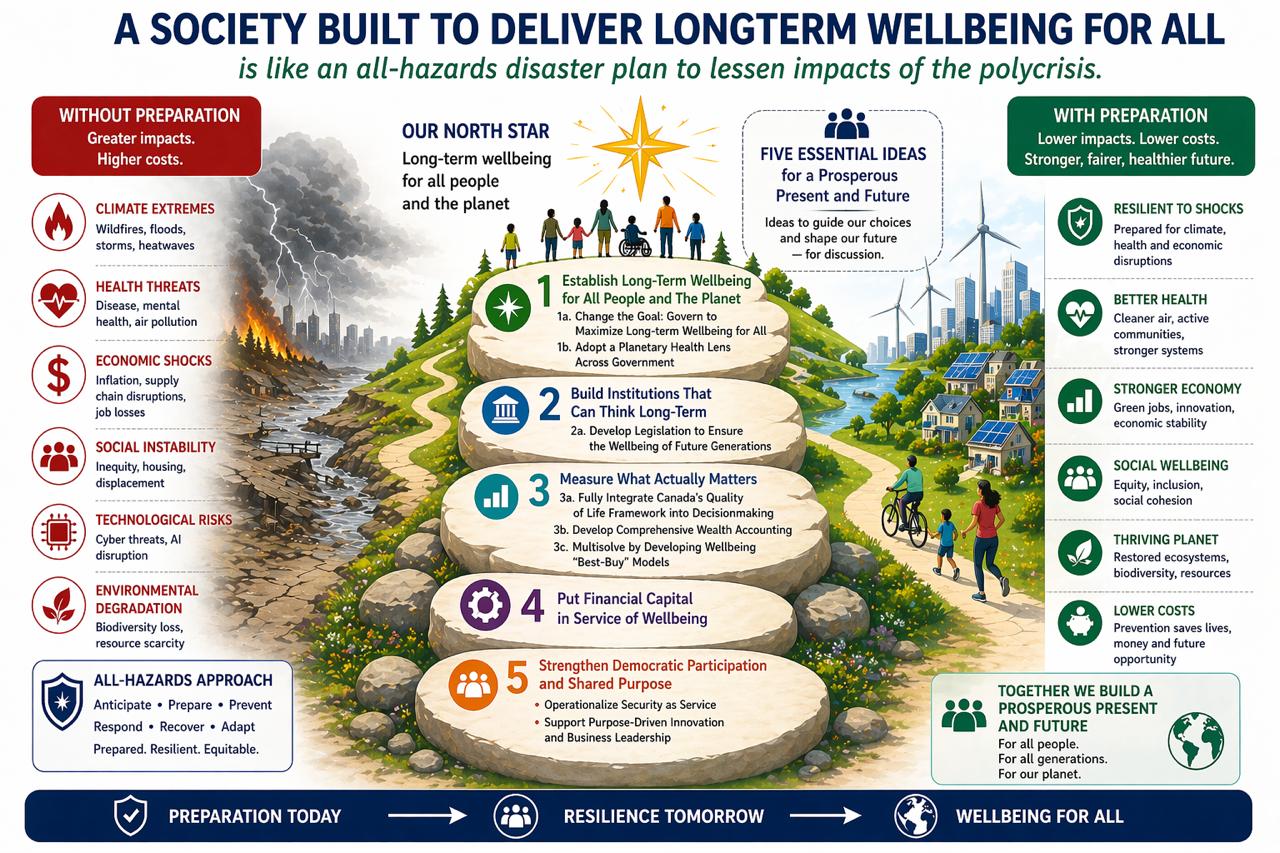
Wellbeing Society
Towards a new societal operating system for the 21st century — one that places long-term wellbeing for all people and the planet at its core.

Risks to the Foundations of Wellbeing
These risks are interconnected and cascade across ecological, social, human, and institutional systems.
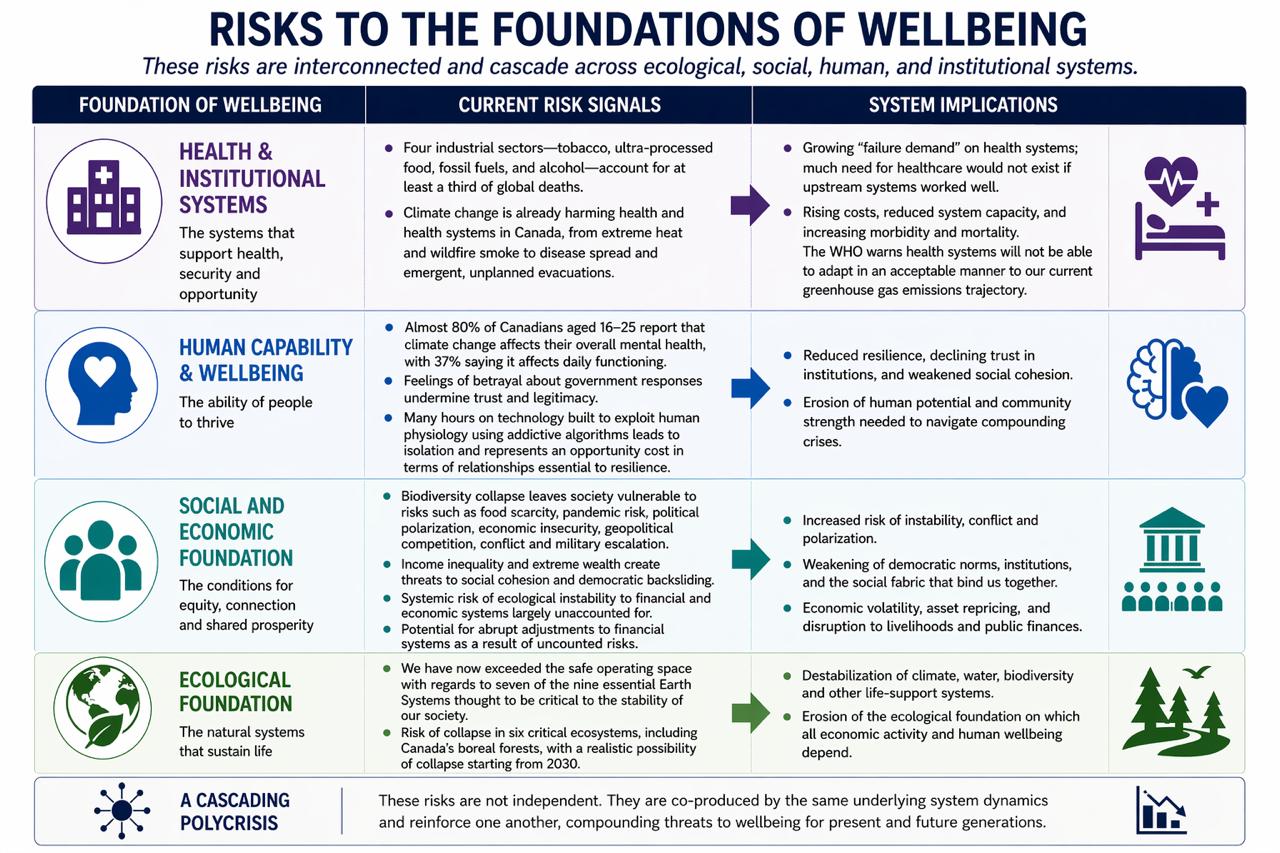
A cascading polycrisis: these risks are not independent — they are co-produced by the same underlying system dynamics and reinforce one another.
From Wellbeing to GDP — and Back
In the late 1700s economist-philosophers identified welfare, or wellbeing, as the goal of human society. However, in the era before modern computing, economists simplified this objective in order to be able to model the economy. Over time, wellbeing became proxied by money, and economic models came to assume "homogeneous, rational, utility-maximizing agents interacting in timeless self-equilibrating markets." Later, we adopted Gross Domestic Product as a default goal for society despite explicit warnings from Simon Kuznets, its originator, that a measure of national production could not measure welfare.
The use of financial capital as a proxy for wellbeing left us with relatively unmeasured and ungoverned stocks of ecological, human and social wealth. As a result, we have been growing money, hoping that wellbeing would result, but too often what appears as income, profits, and economic growth reflects the liquidation of the human capability, natural wealth and social cohesion that form the foundations of prosperity.
Rational decisions taken to maximize short-term objectives within this system thus result in behavior that is detrimental to our current and future wellbeing: companies that sell unhealthy food to kids without picking up the tab for the treatment of their early-onset diabetes; AI technologies that create value for a few by learning from existing knowledge without compensation for creators; and businesses that freely deplete natural wealth. What appears as economic growth often reflects the liquidation of the natural wealth and social cohesion that are key to the stability of our planetary health nest.
Increasing levels of preventable illness in children, teetering Earth systems, economic instability and rising social polarization are not isolated factors: they are the inevitable result of the goals, metrics, and incentives of our system.
A Tipping Point in Human History
We are at a tipping point in human history. Earth system risks are rising. Geopolitics are unstable. But we have also reached positive tipping points: in clean energy, in sustainable health care, and in our growing ability to measure and model interrelationships between prosperity, security, health, ecological systems and strong social foundations.
Canada needs to continue its path towards wellbeing governance and develop a new societal operating system for the 21st century.
From Wildfires to Wellbeing
See POWER's founder, Dr. Courtney Howard, outline a pathway from Wildfires to Wellbeing in this Walrus Talk.
Planetary Health Roundtable at the Senate of Canada
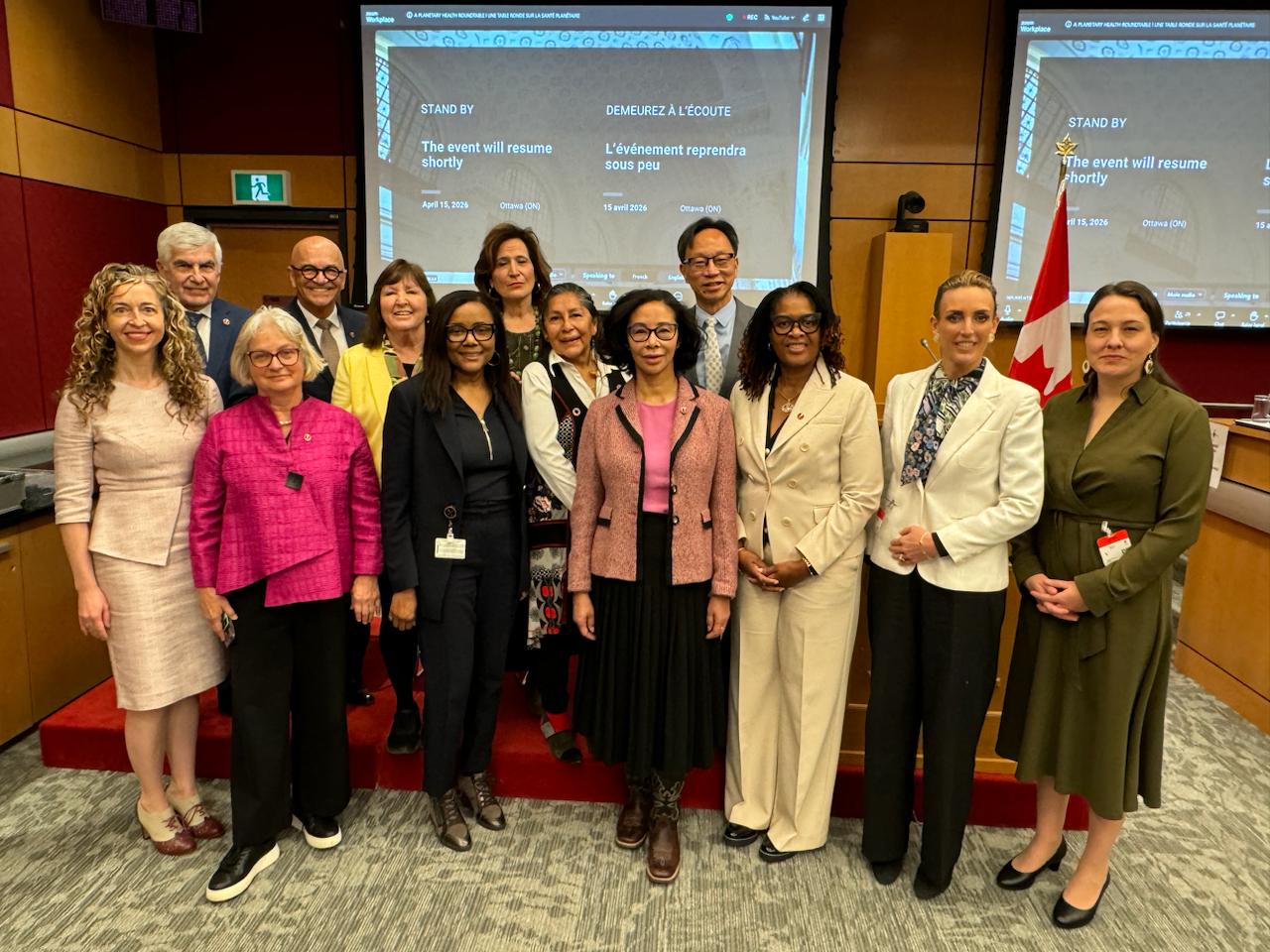
Planetary Health Roundtable at the Senate of Canada — April 15, 2026, Ottawa.
POWER was honoured to support the Planetary Health Roundtable at the Senate of Canada sponsored by Senators Mary Coyle, Éric Forest, Rosa Galvez, Clément Gignac, Mary Jane McCallum, Julie Miville-Dechêne, Tracy Muggli, Manuelle Oudar, Flordeliz (Gigi) Osler, Sandra Pupatello, Paulette Senior and Yuen Pau Woo, together with Members of Parliament Alexandre Boulerice, Sophie Chatel, Elizabeth May and Éric St. Pierre.
It featured Dr. Johan Rockström, Dr. Nicole Redvers, and Dr. Victoria Hurth, moderated by POWER founder Dr. Courtney Howard. The event was put on in collaboration with Social Innovation Canada, Waterloo Institute for Complexity and Innovation, Canadian Network for Complex Systems, and the Group of 78.
A White Paper on Canada's Path to a Wellbeing Society
POWER is working with Dr. Galvez' office on a follow-up White Paper on next steps to a wellbeing society in Canada, for release in late spring 2026.
Support our work